The composers
Prague's composers at St Giles'
Mozart, Smetana and Dvořák all have a Prague story. Here is what is documented about each, and how their music turns up in a St Giles' Church concert.
Book your seat at St Giles' ↗Quick answer
Mozart, Smetana and Dvořák each have a Prague connection. Mozart's Don Giovanni premiered in the city on 29 October 1787, and his Symphony No. 38 first sounded here in January 1787. Smetana wrote the Vltava in 1874, and Dvořák was a Prague church organist in the 1870s. The St Giles' Church concert names all three, with Vivaldi and Albinoni, among its composers.
Mozart: the visit of 1787
Mozart visited Prague in January and February 1787. His Symphony No. 38 in D major, K. 504, was first performed in the city on 19 January 1787, which is why it is nicknamed the Prague Symphony. It has three movements and no minuet, which was unusual for a Viennese symphony of the time. The commission for Don Giovanni followed the visit, with a libretto by Lorenzo Da Ponte, and Mozart finished the score on 28 October 1787, the night before the premiere. The opera premiered on 29 October 1787 at the Estates Theatre, and a Prague newspaper reported that the city had never heard the like.
Smetana: the river
Bedřich Smetana composed the Vltava between 20 November and 8 December 1874, and it was first performed on 4 April 1875. It is the second of the six symphonic poems of Má vlast, which he wrote between 1874 and 1879. The music follows the river from its two small springs through woods and meadows, a farmer's wedding and moonlit dances, and ends as the river widens and flows towards Prague, past Vyšehrad. A performance takes about thirteen minutes. The St John's Rapids that the piece depicts no longer exist, since the Štěchovice Reservoir flooded them. If your date names Smetana, the Vltava is the piece he is best known for.
Dvořák: the organist
Antonín Dvořák was born on 8 September 1841 in Nelahozeves, near Prague. He entered the Prague Organ School in 1857 and graduated in 1859. From 1862 to 1871 he played viola in the orchestra of the Provisional Theatre, and from 1874 to 1877 he was organist at St Adalbert's Church in Prague. He submitted his Slavonic Dances, Op. 46, in 1878, after Brahms recommended him to the publisher Simrock, and a second set, Op. 72, followed in 1886. In 1893 he wrote the New World Symphony in New York. A composer who earned his living at the organ is a fitting name for an evening in a church with an organ and a soprano on the bill.
Albinoni and a famous Adagio
Tomaso Albinoni was born in Venice on 8 June 1671 and died there on 17 January 1751. He is remembered today for his instrumental music, especially his oboe concertos, though in his own time he was best known as an opera composer. A piece called the Adagio in G minor is attributed to him, but it was largely written by the 20th-century musicologist Remo Giazotto, who catalogued Albinoni's works. If a programme prints the Adagio under his name, you now know the story behind it.
Reading the programme
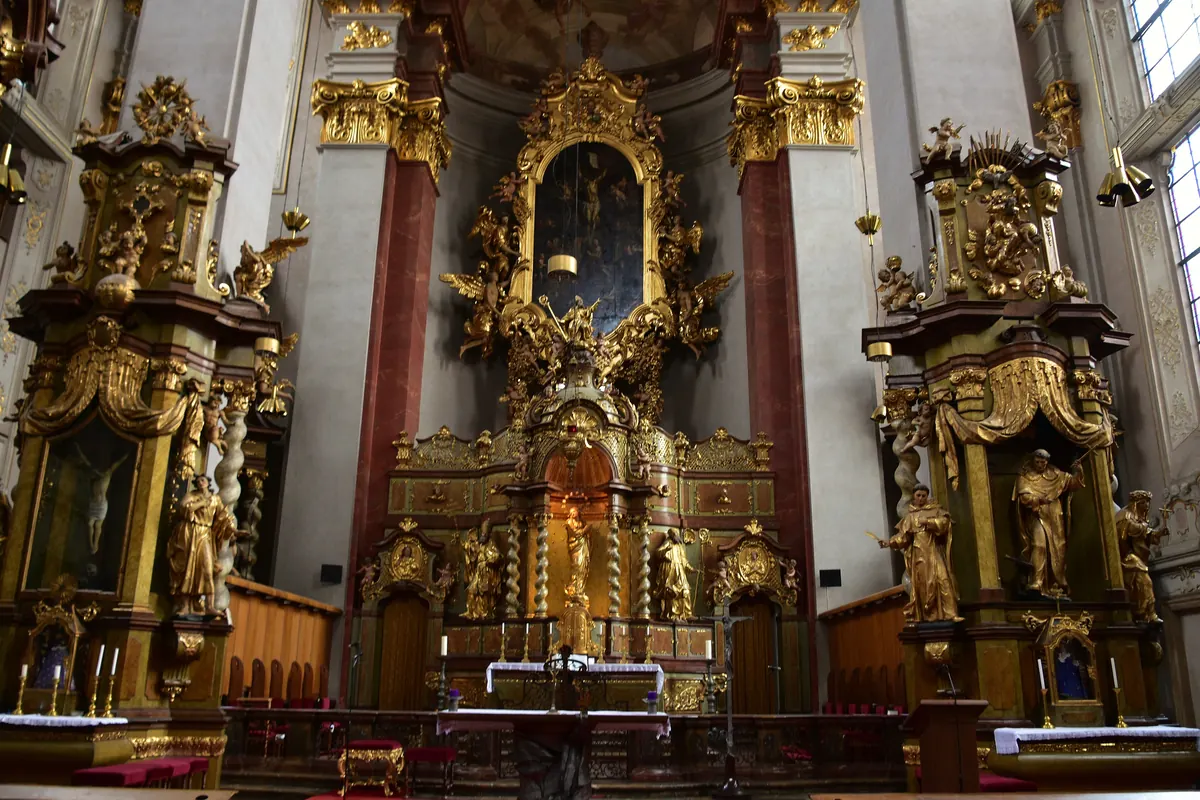
The printed programme that comes with the ticket names each piece. Because the series rotates its composers, the evening may lean towards Vivaldi, towards Mozart or towards the Czech composers. Dates differ, so compare the calendar entries. The soprano and the organ mean the evening can include vocal music and organ-and-strings pieces as well as orchestral ones. Whichever date you choose, the setting stays the same: a Baroque church with painted vaults, where the music is played by a chamber ensemble with a soprano, an organist and a solo violinist.
Read next: St Giles Church concert, Prague
Frequently asked questions
Did Mozart visit Prague?
Yes, in January and February 1787. Don Giovanni premiered there on 29 October 1787.
What is the Vltava?
The second of six symphonic poems in Smetana's Má vlast, about the river that flows through Prague.
Was Dvořák an organist?
Yes. He studied at the Prague Organ School and was organist at St Adalbert's Church from 1874 to 1877.
Will all of them be played?
No. The programme depends on the date, and the printed programme lists the pieces.
Sources